at last… a homemade jerk seasoning recipe that works

For more than five years, we have been living in Australia, far away from the comfortingly-stocked shelves of our local Tesco in Brent Cross where the international food choices were staggering. With such a huge population in the area of West Indian descent, there was never any problem buying Orlando’s –and subsequently my – favourite West Indian foods and seasonings.

Ackee and saltfish was delicious, easy and cheap to make for dinner. If we needed more jerk seasoning or pepper sauce (a traditional Barbados favourite), we popped down the road either to Tesco or to any of our local groceries, and picked up a jar of Walkerswood or a bottle of Windmill.

Now we live in Australia, we have to remember to stock up if either one of us goes to London. Happily, our trip to Barbados afforded us the chance to send back some decent quantities of jerk seasoning, pepper sauce and tins of ackee.

But how to become more self-sufficient? A few of our West Indian acquaintances here in Australia make really decent home-made pepper sauce or jerk seasoning, but I have never been able to come close. Perhaps it was the fresh Bajan air, or the amazing assaults on my taste buds every evening at dinner, but upon my return this time I think I have cracked it.

The most important thing to get right is the fresh chillies. Australia-dwellers, this is important: you will not find the chillies you need in Safeway. What we really need are habanero chillies but they are not sold in this country. So you need to go down to the local market or your local Asian grocery and ask for the hottest fresh chillies you can find. I get mine from Bharat Traders here in West Footscray, tiny green ones that look like this (they are on a side plate if that gives you an idea of size). I used about 12 of these for one batch of seasoning (enough to season about 1 kg of meat) and to be honest I could have done with a bit more heat still. Deseed before you use if you wish – I didn’t bother.

The second important ingredient is all-spice. Many people think this is a mixture of spices used in baking, but that is mixed spices. All-spice is the fruit of the Jamaican pimiento tree and is a very specific ingredient. Happily, although you cannot get the pimiento berries themselves here in Australia, we can buy ground all-spice in most big supermarkets. It’s not the same but it does the job.

The third thing is the tool you use. You will need to get this mixture ground down as smooth as possible, so the best results will be obtained from a blender or from a pestle and mortar. I have only used a food processor so far, which chops very finely indeed but it is not enough to make the seasoning paste really sink into the meat.

So, here you go. Give it a try and roast your own jerk chicken for dinner this weekend.

Ingredients (enough to season about 1kg of chicken)
3-4 large scallions or spring onions
6-12 hot chillies
small bunch of fresh thyme
2-3 teaspoons of allspice powder
1-2 teaspoons of ground nutmeg or the freshly-ground equivalent
1-2 teaspoons sugar
juice of half a fresh lime
freshly-ground salt and black pepper

Other people add some ginger, or coriander. I am going to try and add some native Australian herbs and spices, like lemon myrtle or pepperberry, and see how that goes.

Method
De-seed the chillies if you wish. Chop up the scallions and chillies as finely as you can. You can use onion if you are stuck, but I find the onion rather overpowers the balance of flavours too much.
Remove the leaves of the thyme from their woody stems by stripping each stalk backwards. Don’t worry about being too finicky with this.
Throw all ingredients into a blender or food processor and blend until as smooth as you can get it. If you don’t have a blender, start by chopping everything as small as possible and then use a pestle and mortar to crush the onions, chillies and thyme into as smooth a paste as you can manage. Update: having now used a pestle and mortar, a food processor and a blender, I would have to say the blender gives you by far the best results.

This seasoning will keep in the fridge in a sterilised container for a week or two if you don’t use it all at once. If you add a little white vinegar to the mix at the end of the blend, this will help with longevity.Rub a small amount of the seasoning onto each joint of meat – I use no more than 2-3 teaspoons per chicken joint or breast. Make sure you get into every nook and cranny. Then cover and leave for as long as you can – overnight if possible, but at least an hour if you are in a hurry.

Roast slowly and enjoy the beautiful aromas coming from the kitchen!

Serve with rice and peas: soak 2-3 tablespoonfuls of black beans, black-eyed peas or similar overnight. Alternatively use azuki beans which are easily found in Asian markets, and don’t need soaking. Bring to the boil and cook slowly in plenty of water until cooked. DO NOT THROW AWAY THE WATER. Add your white rice and a dash of salt to the cooked peas in the same water (this makes the rice turn a different colour and adds flavour). Stir occasionally until cooked through, then strain the last of the water away and serve up.

laos food odyssey

>Ten days in Laos: a chance to experience a new cuisine, try some new dishes and savour some street food.

I knew little if anything about Laos or its food traditions before we arrived in Vientiane. Immediately the French influence was apparent: fresh baguettes sold in the street, and handful of nice-looking patisseries and decent wine readily available at a decent price. The Scandinavian bakery was doing good business in its own shop and supplying many eateries around town, including our own hotel, with fresh breakfast croissants and more.

But what is a typical Lao dish? The very first thing we tried was laap (also spelt larp), a commonly-served warm salad dish using whatever minced meat you prefer – chicken, pork or beef. Apparently it is also served raw like ceviche but we didn’t see that offered anywhere. The meat is seasoned, cooked then tossed with raw vegetables, usually including mint, morning glory (a river weed cooked as we would use spinach, asparagus or broccoli), bean shoots and spring onion, and served on a bed of lettuce or cabbage leaves. Eaten with sticky or steamed rice it goes down a treat.


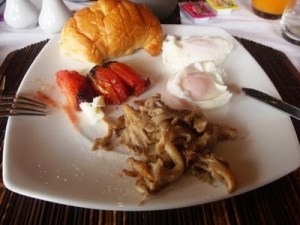
My Western-style breakfast in our Vientiane hotel included the tastiest, freshest eggs I have had for a while, plus some locally-gathered wild mushrooms which were meatier and tastier than any mass-produced white mushrooms we eat at home. Divine. Eggs loomed large most mornings, and we were fortunate enough to have our breakfast/brunch along the riverside for almost every day of our stay in Laos, no matter what the town.

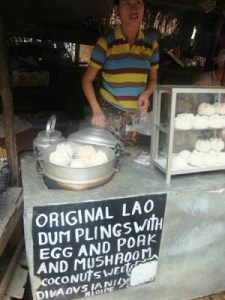
A trip to a local waterfall saw us snacking on Lao pork buns, which were suspiciously like Chinese pork buns except the pork filling was augmented by pieces of hard-boiled egg. Much better!


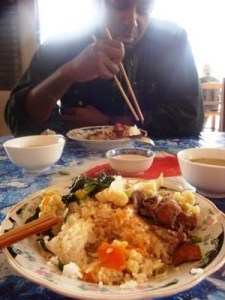
On our road trip to Luang Prabang, our bus ticket included lunch at a basic roadhouse halfway through a ten-hour journey. The food was ready for us as we disembarked: a beef dish and a pork dish, simply seasoned and cooked, and a couple of vegetable dishes, all served with either steamed rice or on top of freshly-cooked noodle soup. Three days into our journey it was just like home cooking and we devoured it. I’m a sucker for something simple with rice.


Luang Prabang is a World Heritage site, and there is no shortage of boutique hotels, cute wine bars and pleasant restaurants. We dined one evening at Tum Tum Cheng, famous for its head chef’s homage to dishes prepared for the Royal household, and its cooking school. The deep fried spring rolls were to die for (this became a popular starter for us in Laos and they never disappointed), but the main courses were a little disappointing. My Luang Prabang stew was tasty enough but bland, and Orlando’s spicy pork was not so spicy. We resorted to our emergency stash of chilli sauce sachets kept in my handbag for just such an event.

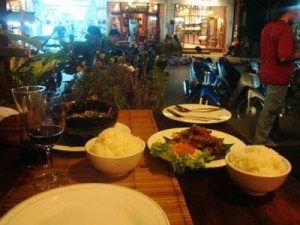
At 150,000 Lao kip (approx. $19) including my 200ml carafe of wine, Tum Tum Cheng was probably one of the most expensive meals of the holiday but in terms of taste and price it was totally eclipsed by the exceptional dinner we had the next night at a little family-run roadside eatery with three tables. Orlando’s “fried pork with chilli and less” (sic) and my “fried mini local noodles with pork” were accompanied by a handful of the tiniest, hottest chillies we’ve ever encountered and cost 40,000 kip (less than $5) for two. Delicious, honest home-cooking again – can’t beat it. We loved it so much we went back next day for lunch.

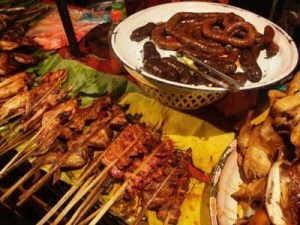
Luang Prabang’s night market was pretty good value for money in terms of eating out. One small laneway was transformed in the evening into a typical Asian food market, with noodle soup, Luang Prabang spicy sausage, barbecued fish, chicken and pork, fresh fruit and more all available for pennies. Totally tourist-oriented unlike most of the other night markets we ate at, the food was nonetheless hearty and nicely presented on a banana leaf.

There were two types of local sausage in Luang Prabang. One looked a little like a black pudding although the inside was much more finely chopped. We tried this one twice, one at a family stall down a back street one afternoon, and once more as a packed lunch on our two-day boat trip up the Mekong (matched with a few triangles of The Laughing Cow longlife cheese: marvellous).
The first sausage was much more herby than spicy, but the second was like a good Italian sausage with just the right amount of chilli kick mixed in. The second type of local sausage was longer and thinner, stuffed with excellent lean pork and again well seasoned. We loved both.

night market delicacies
our boat picnic of Laughing Cow and sausage
(OK I added lime and chilli crisps too!)
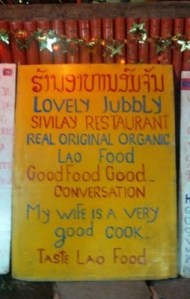
Northwards by boat into the country and smaller villages, we broke our two-day trip up the Mekong in the small village of Pak Beng which is well-placed to cater for travellers thanks to the Lonely Planet. The main (only) street is lined with guesthouses, eateries and a couple of bars. We chose the one with the sign that made us laugh the most: “Lovely Jubbly” restaurant which proudly announced that “My wife is a very good cook”. And she was. We both chose the pork laap which was fresh, perfectly seasoned and most welcome after a long and tiring day lying back on our boat watching the Mekong and its villages float by.

This was our last official meal in Laos too, although we didn’t know it at the time. Next morning we breakfasted on freshly-made minced chicken, egg and salad baguettes made at our guesthouse before embarking for our second day of river travel, and by nightfall we were over the border in Thailand and dining on home-made noodles courtesy of Dan, the campest guest-house host in town.

mammy dinner

>A routine trip to the hospital and a dose of anaesthetic yesterday meant I needed chaperoning overnight. Lee and Mena came to visit, the former to stay over and play nursemaid, and the latter to cook dinner for us.

I was feeling perfectly fine and totally compos mentis, except Lee said I wasn’t really: apparently my intelligence level seemed to have decreased somewhat. Now and again I made a declaration which elicited a puzzled response from her, because apparently I was making no sense whatsoever and even getting simple sums wrong. Horrifying.

Meanwhile Mena arrived and set to work cooking the exact menu that was served in our family home for decades on a Tuesday (and still is). Eggs, beans and chips. Perfect comfort food. I added sausages to the menu, having been to Paddy’s the Irish butcher last week and so having a plethora of pork products to hand.

Nothing fancy: real Heinz beans, two eggs dry-fried sunny side up, and potatoes chipped by hand and oven-cooked with a little spray oil. Irish-recipe pork sausages fried in the pan (they are really low fat and dry-frying them gives a much better browning effect than grilling). The only thing was that I only had regular malt vinegar. A nice onion vinegar would have gone down well with the chips. A good dollop of tomato sauce for dipping (sorry, Andy, it was shop-bought) and it was just the perfect Mammy Food.

I probably shouldn’t have, but instead of washing it down with a nice strong cup of tea, I indulged in a cheeky glass of two of a nice Langhorne Creek shiraz cabernet. Not strictly Irish kosher, but on the eve of St. Patrick’s Day I reckon that was forgivable.

Labour Weekend Foodie Style – Sunday

Labour Day Sunday was time for brunch in Babble On Babylon, the venue for the boys’ cycling lunch most Sundays. Marty runs the only West Indian cafe in town, and his Jamaican breakfasts, stamp’n’gosalad and curried goat are excellent.

We crammed into the back room while the kids played in alley. Nina’s rice and peas and chicken looked excellent – well-seasoned and well-cooked chicken which Orlando manfully helped her polish off.
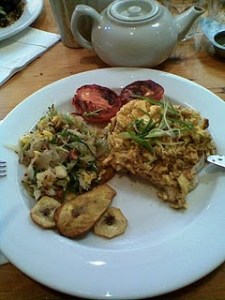
My Jamaican breakfast was just perfect: chilli eggs on toasted sourdough, plaintain, ackee and saltfish, with a side of roasted tomatoes. I never have the johnny cakes because I find them too heavy.

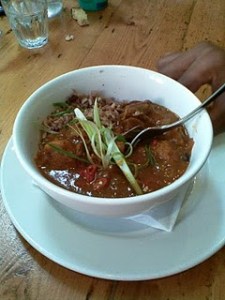
Eric’s big bowl of curried goat (no bones, plenty of spice) went down a treat too.

five memorable meals – are you in?

>At dinner a few weeks ago with Sam, Amanda and Mena, our conversation revolved around food and its significance in our lives. We recalled memorable meals with family or friends, favourite restaurants, unusual or particularly good food in far-flung places when travelling.

Our conversation sparked further thoughts in my head about how food has such a strong place in our memories, connecting us with significant events, people or moments in our lives.

So I would like you to have a think about the five (or so) most memorable meals you have had in your life, and why you think they hold such a special place in your memory. It could be a simple rustic lunch of bread and cheese on a park bench on the side of the road in France, or your first Michelin-starred dinner as a proper grown-up. It could be alone when travelling on business, or in the heart of your family at Christmas or on a birthday. It could be home-cooked, shop-bought or served in an eatery. The link is its significance to you.

I think the trick might be not to think too much about it. What are the first images (or aromas, or tastes) that go through your head when you think about this? These are probably the places to start.

I shall deliberate upon my own list this week and share with you here on this blog. In the meantime have a think about your list, then either write a post on your own blog, or a note on your Facebook page, and make sure you share a link with me so I can collate all the responses. Or email me if you wish and I can add your list to my blog.

Just jot down a few words about when and where the meal took place, who you were with (if anybody), what you ate (which can be in detail or very brief, depending on how you are remembering it) and why you think this particular event is so memorable to you. Be as brief or as lengthy as you can: it’s the stories you are telling that I am interested in.

Begin!